How to Read Waking Earth
Western plot, Eastern myth, and stories shaped by karma
Read for the Plot
Follow the mystery, danger, monster, romance, pursuit, betrayal, and final confrontation.
Read for the Pattern
Watch what keeps returning: karma, craving, attachment, delusion, vows, memory, and unfinished suffering.
The Familiar Doorway
Most Western readers are trained to ask a simple question when a story begins: what is the conflict, and how will it be resolved?
That question still matters in The Waking Earth. There are murders, mysteries, monsters, conspiracies, broken families, dangerous romances, cursed objects, unseen realms, metaphysical danger, and people making terrible choices under pressure. The books use many familiar Western forms: noir, gothic horror, urban fantasy, thriller, historical fiction, tragic romance, and the occasional strange road trip through impossible territory.
Those forms matter. They give the stories urgency. They create danger, suspense, investigation, pursuit, betrayal, and consequences. But they are the familiar doorway, not the deepest structure.
The deeper question is not only whether the conflict can be resolved. The deeper question is whether the pattern can be seen.
That is the Eastern movement beneath the Western surface. Not simply victory over an enemy, but recognition of the forces that keep returning: karma, craving, attachment, delusion, inherited suffering, unfinished vows, and the illusion of a separate self.
The mystery matters. The monster matters. The romance matters. The final confrontation matters. But beneath them all is the question the books keep returning to: What has this suffering made visible?
Conflict and Revelation
In many Western stories, the plot moves through escalating conflict. A problem appears. A hero is forced to act. The danger grows. The hero confronts the villain. The conflict reaches a climax, and the story resolves through victory, defeat, or sacrifice.
The Waking Earth uses that kind of momentum, but it is also shaped by another kind of movement: introduction, development, turn, and revelation. The story may not always be asking, “How does the hero win?” Sometimes it is asking, “What pattern has been hidden here, and what happens when it is finally seen?”
That difference matters.
A Western-style plot often moves like a line toward a decisive confrontation. An Eastern-influenced mythic structure may move more like a wheel, a river, or a returning dream. Events repeat, but not pointlessly. People encounter the same wound, the same desire, the same mistake, the same vow, or the same unfinished relationship until something changes. The plot still moves forward. But it also circles downward and exposes.
The Cycle Is the Deeper Enemy
These stories do not always reduce cleanly to hero versus villain.
A useful example is Journey to the West. On the surface, it contains monsters, demons, battles, temptations, punishments, and supernatural danger. But the deeper story is not simply Sun Wukong defeating one enemy after another. The journey itself is the point. The pilgrimage reveals pride, appetite, fear, discipline, loyalty, delusion, and the long work of transformation.
The deepest obstacle is not one demon waiting at the end of the road.
The deeper obstacle is the pattern the travelers must pass through.
That is also one of the ways Under the Cycle works. The deepest enemy is rarely a single person. The deeper enemy is The Cycle itself: ignorance, craving, violence, attachment, false identity, inherited suffering, and the way beings keep mistaking one more battle for freedom.
This does not mean the books excuse cruelty. Karma is not an excuse. The harm done in these stories still matters. The dead are still dead. The wounded still carry wounds. The betrayed still remember. But karma also means that no one stands outside consequence, and no one is forever separate from awakening.
The Group Is the Story
This is why groups matter so much in these books. In Journey to the West, the pilgrimage does not belong to one lone hero. Tripitaka, Sun Wukong, Zhu Bajie, and Sha Wujing are not interchangeable companions trailing behind the “real” protagonist. Each carries a different flaw, strength, burden, and role within the journey. Their conflicts matter. Their loyalty matters. Their failures matter. The group changes because each member of the group is part of the lesson.
The same is true in The Waking Earth.
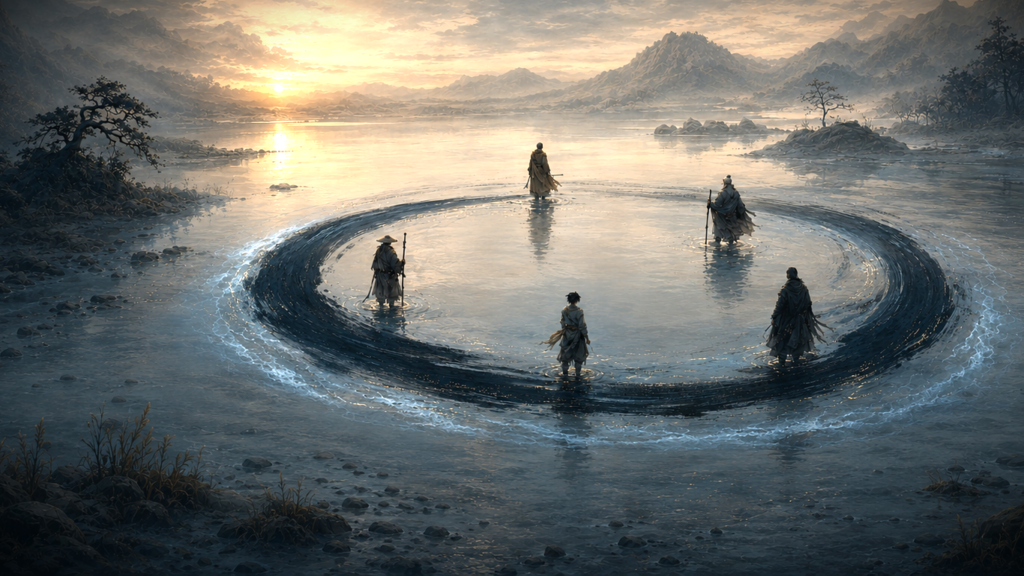
The story does not usually belong to one lone hero standing apart from everyone else. It belongs to circles of people bound together by karma, memory, duty, love, debt, pain, vows, family, rivalry, and unfinished business.
One character may carry power. Another may carry memory. Another may carry faith, guilt, lineage, anger, or the missing piece of the truth. A teacher, enemy, spouse, ghost, child, detective, priest or witness may all hold part of the pattern.
The group is not decoration. The group is the story.
This is one of the places where The Waking Earth leans toward Eastern mythic storytelling. The question is not only, “What can the hero do?” It is also, “Why have these people been brought together?” A companion may reveal a truth the hero cannot see. A rival may expose a hidden weakness. A child may carry the future. A ghost may carry the past. An enemy may carry the wound everyone else is trying not to name. The story moves because the circle changes.
There Are No Permanent Villains
Under the Cycle there are harmful actions. There are cruel actions. There are people who kill, betray, manipulate, exploit, consume, and destroy. But there are no permanent villains.
A villain is a fixed identity. The Waking Earth does not treat beings as fixed.
Someone may be at odds with another person for ten minutes, ten hours, that lifetime, or ten lifetimes. They may be an enemy in one age and a companion in another. They may be a protector in one life and a source of harm in the next. They may oppose each other so completely that reconciliation seems impossible. But over a long enough timeline, everyone ends on the same side.
This is why enemies can become companions. It is not merely a plot twist. It is part of the metaphysics of the world. If the true enemy is The Cycle, then the person across from you may not be your final enemy. They may be another prisoner of the same wheel.
A Different Set of Questions
A Western reading may ask: What is the conflict, and how will it be resolved?
A Waking Earth reading also asks: What pattern is being repeated, who is bound to whom, and what would it take for the pattern to end?
Neither way of reading is wrong. They simply notice different things. If you read only for the external conflict, you will still find battles, investigations, betrayals, monsters, and danger. But if you read for the deeper pattern, you may notice that the story is also asking what binds people together across time, what they refuse to see, and what kind of freedom becomes possible when the pattern finally breaks.
Power, Discipline, and Cost
Power works differently here too.
In many Western stories, power is measured by force: who is stronger, faster, more dangerous, or more capable of defeating the enemy.
In The Waking Earth, power may include those things, but it is also shaped by discipline, vows, lineage, ritual, restraint, spiritual cost, and karmic consequence. A character’s ability is not only a tool. It is also a burden. A gift may bind as much as it frees. A ritual may protect one person while trapping another. A vow may survive beyond the life of the person who made it. Training matters, but so does what the training was for.
Strength without wisdom can become another turn of The Cycle. That is why some of the most important acts in these stories are not acts of domination. They may be acts of restraint, recognition, confession, mercy, remembrance, or release.
Folklore Is Alive
The old things are alive in this world. Folklore is not treated as primitive superstition. Myths, spirits, rituals, monsters, sacred objects, ghosts, and religious symbols may be distorted, misunderstood, exaggerated, or misremembered, but they are often pointing toward something real.
The stories people tell may be wrong in detail and still true in essence.
The realms, spirits, monsters, curses, and impossible events in The Waking Earth are not simply there to make the world stranger. They reveal what ordinary life hides. They make invisible forces visible.
A hungry ghost is not only a ghost. A serpent woman is not only a monster. A curse is not only a threat. A realm is not only a setting. Each one is a way of seeing desire, fear, grief, attachment, delusion, violence, compassion, and liberation under pressure.
Repetition With Consequence
The Cycle does not mean simple repetition. It means repetition with consequence.
People return to the same wounds, the same cravings, the same mistakes, the same bonds, and the same unfinished business until something changes. Sometimes that change comes through love. Sometimes through suffering. Sometimes through memory. Sometimes through someone finally seeing clearly what everyone else has mistaken for fate.
This is why the past matters so much in these stories. The past is not gone. It is still acting. It may appear as memory, haunting, lineage, curse, vow, inheritance, instinct, or desire. But it is still present. To break The Cycle, a character must often do more than win. They must understand.
Both Traditions Matter
This is not a claim that Eastern storytelling is better than Western storytelling, or that Western storytelling is shallow. The Waking Earth depends on both. Western storytelling gives the books drive, danger, structure, and urgency. Eastern myth gives them recurrence, karmic depth, transformation, and the long view.
The books live in the overlap. A reader can follow the mystery, fear the monster, enjoy the action, and care about the romance. But beneath that surface, another question is always moving.
Questions to carry while reading
• What is being repeated?
• Who is bound to whom?
• What has this person mistaken for freedom?
• What would it take for the pattern to end?
The Long View
You do not need to be Buddhist, Eastern, academic, or mythology-fluent to read these books. They are meant to work first as stories. But if you feel something older moving beneath the plot, you are not imagining it. The Waking Earth is a world of conflict, but conflict is not the deepest truth.
The deeper truth is relationship. The deeper question is not always whether the hero can defeat the villain. The deeper question is whether these characters can recognize the cycle they are trapped inside before they mistake one more turn of it for freedom.