The Three Poisons
The Hidden Engine Behind The Waking Earth and Our World
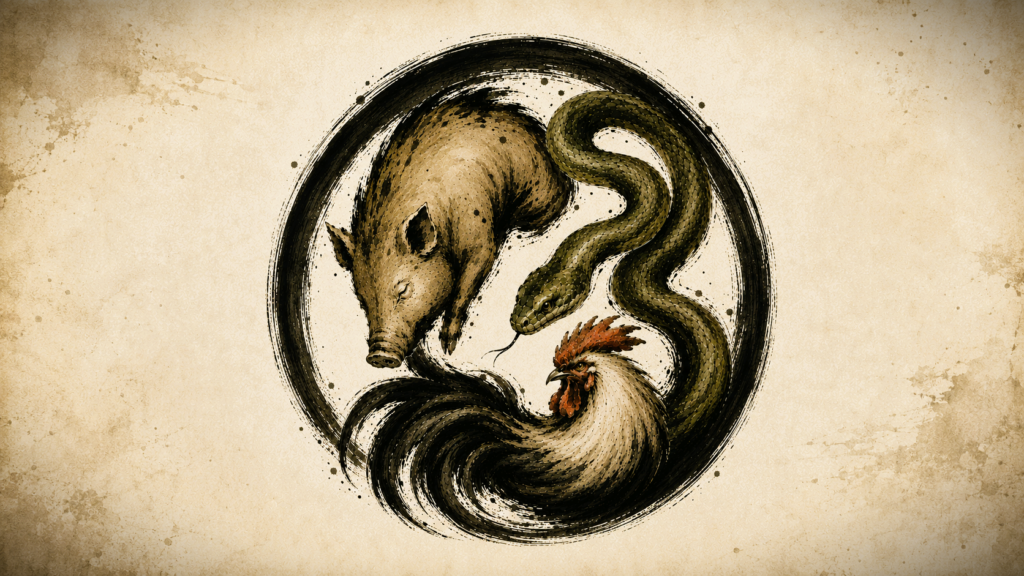
The three poisons are not merely symbols in Buddhist art. They are the hidden engine of suffering: greed grasping for satisfaction, hatred resisting what it fears, and delusion misunderstanding the nature of the whole process.
The Image at the Center
At the very center of the Buddhist Bhavacakra, the Wheel of Life, there is a small but profound image: a pig, a snake, and a rooster chasing one another in a tight, endless circle. The pig represents delusion, the snake represents hatred or aversion, and the rooster represents greed or craving. Their arrangement is deliberate. Each bites the tail of the next, showing that none exists independently. Greed gives rise to hatred when desire is frustrated. Hatred clouds perception, deepening delusion. Delusion, in turn, gives birth to new craving as the mind grasps for relief from the suffering it does not understand. Together, they form a self-sustaining engine, one that Buddhism identifies as the true source of suffering.
Where the Poisons Begin
The most important aspect of this teaching is not simply that these poisons exist, but where they exist. They do not originate in governments, economic systems, or social structures. They originate in the individual mind. External systems can amplify greed, channel hatred, or obscure delusion, but they do not create them. Nor can they eliminate them entirely. This insight stands in contrast to one of the most common assumptions of modern thought: that suffering is primarily structural, and that if the right system can be designed or implemented, the problem of human suffering will be solved at its root.
Systems Are Downstream
From a Buddhist perspective, systems are not the origin of suffering but its expression. They are downstream of the mental states that create and sustain them. Greedy minds create systems that reward accumulation. Fearful minds create systems built on control and exclusion. Deluded minds create systems that mistake temporary solutions for permanent ones. Once established, these systems reinforce the very mental states that gave rise to them, forming a feedback loop that can persist for generations. Yet even when systems are radically altered, the underlying poisons remain. They simply find new objects, new justifications, and new forms through which to operate.
The Deeper Buddhist Diagnosis
This is why the Buddha’s diagnosis went deeper than any particular social critique. He did not teach that suffering comes from this or that arrangement of society. He taught that suffering arises from craving itself, from the mind’s persistent tendency to grasp, resist, and misunderstand the nature of reality. At the root of this process lies delusion, the most fundamental of the three poisons. Delusion is not mere ignorance in the sense of lacking information. It is a misperception of where the problem truly lies. It convinces us that satisfaction can be secured permanently through acquisition, that peace can be achieved by eliminating what we dislike, or that fulfillment can be engineered through external rearrangement alone. Even when conditions improve, the mind continues to generate dissatisfaction, because the underlying mechanism has not been seen clearly.
The Cycle in The Waking Earth
This understanding forms the philosophical heart of The Waking Earth. In that world, the central antagonist is not a tyrant, an empire, or a conspiracy. It is The Cycle itself, a structure that persists not because it is enforced from outside, but because it is sustained from within. The Cycle represents the recursive nature of craving, aversion, and misperception. It cannot be defeated through force, because force operates within its logic. Instead, the only true escape comes through seeing it clearly. The characters who move closest to liberation are not those who destroy their enemies, but those who understand the nature of the prison they inhabit. The bars were never merely external. They were perceptual.
The Poison We See in Others
One of the most subtle and dangerous manifestations of delusion is the certainty that the poisons exist primarily in others. When individuals or groups become convinced that greed, hatred, and ignorance belong exclusively to their opponents, they often fail to recognize the same forces operating within themselves. This blindness allows the poisons to operate unchecked, even in the name of justice or progress. Buddhism identifies this tendency as conceit. It is not simply arrogance, but a deep identification with a position that obscures self-examination. The result is that the poisons perpetuate themselves, even within movements that seek to eliminate them.
The Antidotes
The Buddhist path does not deny the importance of improving external conditions. Compassion naturally expresses itself in efforts to reduce harm and alleviate suffering wherever possible. But it recognizes that no external arrangement can substitute for inner transformation. The antidotes to the three poisons, generosity, compassion, and wisdom, cannot be imposed by decree. They must be cultivated through insight and practice. They arise when individuals begin to see clearly how suffering is created and sustained within their own experience.
The Path Beyond the Wheel
This teaching is both humbling and empowering. It humbles because it reveals that the roots of suffering are closer than we might wish, embedded in the ordinary operations of our own minds. But it empowers because it places the possibility of freedom within reach. By understanding the poisons directly, by recognizing their movements and their consequences, it becomes possible to weaken their hold. This does not instantly transform the world, but it changes the source from which the world is continuously being shaped.
In this sense, The Waking Earth is not only a fictional setting. It is a reflection of a deeper truth. The Cycle persists wherever the three poisons persist. And the path beyond it begins not with the conquest of an external enemy, but with the clarity to see what has always been present at the center of the wheel.